
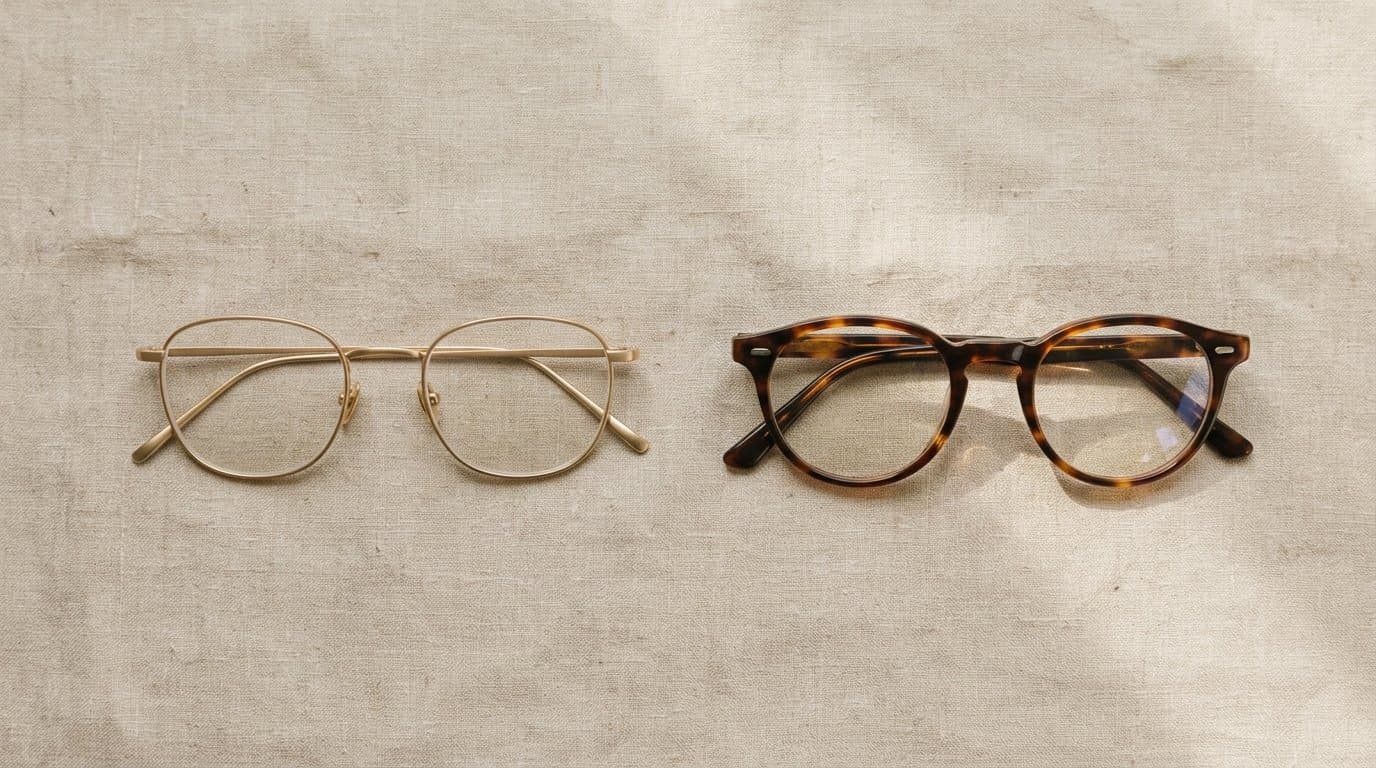
If you have only ever worn one pair of glasses for everything, the choice is simple. But once your eyes start focusing differently at different distances — most commonly from your forties onward — you have a real decision to make. The main options are single-vision, bifocal and progressive lenses, and the right one depends on how many distances you need to see clearly.
Single-vision lenses
A single-vision lens has one prescription across the whole lens. It corrects one distance — near, intermediate or far — and does it very well. Most people who are near-sighted or far-sighted wear single-vision glasses, as do people who only need help for one task such as reading or driving.
- Best for: one clear focusing distance across the entire lens.
- Common uses: everyday distance glasses, dedicated reading glasses, computer-only glasses.
- Upside: the widest, simplest field of view and usually the lowest cost.
Bifocal lenses
A bifocal splits the lens into two zones with a visible line: distance up top and near vision in a segment at the bottom. It is a proven, straightforward way to cover two distances in one pair. The trade-off is the visible line and a sudden jump between the two zones, with no dedicated middle distance for things like a computer screen.
Progressive lenses
A progressive lens covers distance, intermediate and near in a single lens with no visible line. The prescription changes gradually as you look down, so you glance up for distance, straight ahead for a screen, and down for reading. It is the most natural way to handle multiple distances, which is why many people who need reading help choose progressives.
- Best for: seeing near, middle and far distances with one pair.
- Upside: no line, and a smooth transition between distances.
- Worth knowing: the sides of the lens carry some softening, so most people take a short while to adapt. Larger, well-fitted frames give the corridor more room.
How to decide
Start from your day. If everything you need to see is at one distance, single-vision is the clearest and simplest answer. If you find yourself swapping between reading and looking up — or holding your phone at arm's length to focus — a progressive lets one pair do both. Your prescription, your frame choice and the tasks you do most all feed the decision, which is why it is worth talking through with an optician rather than guessing.
Whichever design you choose, the quality of the fit matters as much as the lens itself. Accurate measurements make sure the right part of the lens sits in front of your eyes, so the correction lands where you actually look.
References
- American Academy of Ophthalmology — Pros and Cons of Progressive Lenses — adaptation period, peripheral distortion, fit
- American Academy of Ophthalmology — What is the difference between no-line bifocals, progressive bifocals and trifocals?